Check Half-Frame Portrait Composition and Lab Scanning Options
Key Takeaway
Check whether your half-frame camera normally shoots portrait images, and tell the lab you used half-frame. The PENTAX 17 provides an example for comparing frame sizes, shot counts, and scan options.
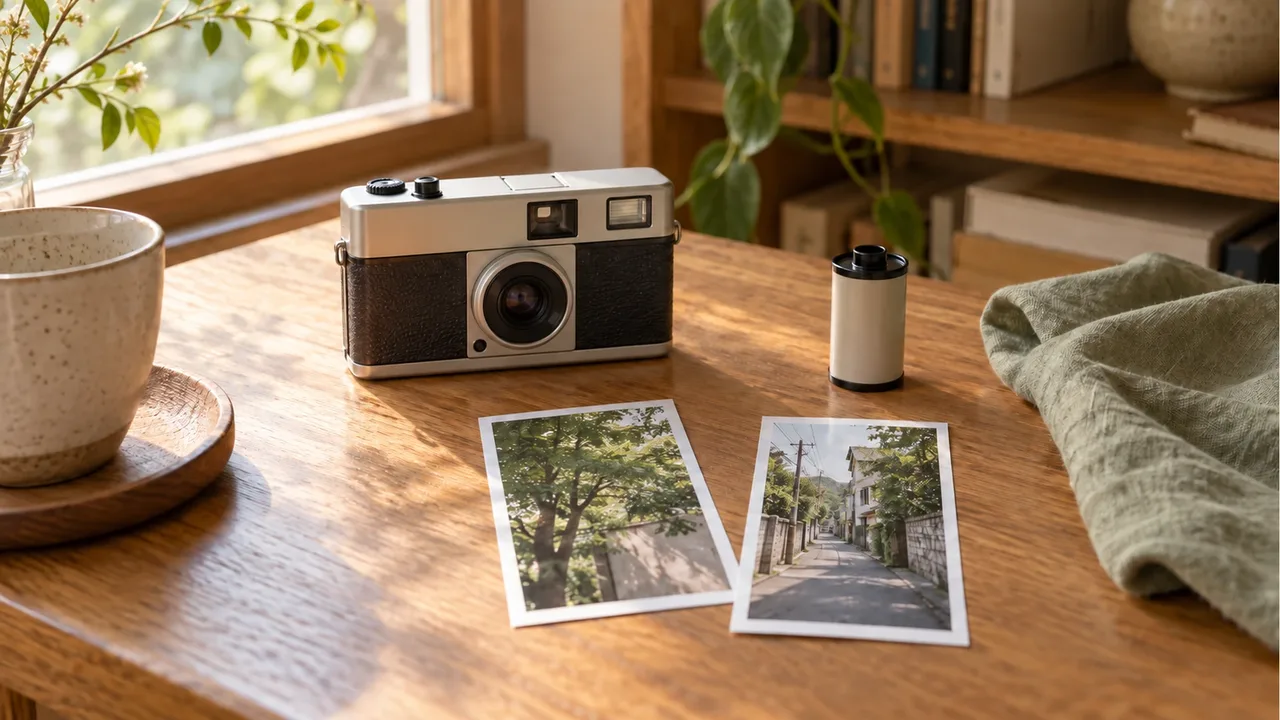
How does the size of each half-frame picture differ?
Ricoh Imaging describes standard 35mm and half-size frames as shown below. Each image takes up less of the same film, increasing the number of pictures.
| Comparison | Standard 35mm frame | PENTAX 17 half-size frame |
|---|---|---|
| Size of each frame | 36×24mm | 17×24mm |
| Pictures on 36-exposure film | Based on 36 pictures | Manufacturer lists 72 pictures |
| Pictures on 24-exposure film | Based on 24 pictures | Manufacturer lists 48 pictures |
Ricoh Imaging's features page was checked on October 17, 2026. The table compares film frames and shot counts. It does not mean scan pixel dimensions or lab service terms also double.
Check frame dimensions in the product specifications. Do not apply every PENTAX 17 detail to all cameras described as half-frame.
Why does a normal camera hold produce a portrait image?
The PENTAX 17 advances film horizontally to create its half-size frames. The manufacturer explains that holding the camera normally produces portrait images, similar in orientation to smartphone photos.
For a scene you want to frame horizontally, rotate the camera and recompose through the viewfinder. For tall subjects such as trees or buildings, try the normal hold first. A smartphone-like orientation does not mean you can review a picture immediately after taking it.
What should you ask the lab?
Ricoh Imaging says to tell the lab the roll was shot in half-size format. After explaining that, ask the following questions.
- Check whether the lab accepts half-frame film for development and scanning.
- Ask whether each picture can be delivered as a separate file.
- Check the pixel dimensions and format of the files provided.
- Ask about half-frame scanning charges and how the service is billed.
These are questions to ask before ordering. The manufacturer's material does not guarantee an individual lab's file separation, scan specifications, or charges. A higher shot count does not guarantee a lower total cost.
Which shooting plans suit this format?
If you want to record many scenes in portrait orientation over a day, consider both the normal framing and the increased shot count. If you want to finish a roll quickly to see the developed results, factor in the extra pictures needed to finish it.
Before buying, try framing subjects you often photograph through the viewfinder. Ask your intended lab in advance whether it can deliver each picture as a separate file.
Frequently Asked Questions
Does half-frame mean the camera focuses automatically?
Frame size and focusing are separate specifications. The PENTAX 17 uses zone focusing with manual selection. Do not assume a half-frame camera has autofocus.
Can I load 120 film?
The PENTAX 17 takes 35mm film. Half-frame describes the image size on that film, not a switch to another film format.
Does its 25mm lens cover the same angle as a 25mm lens on a full-size 35mm camera?
The PENTAX 17 specifications describe its 25mm focal length as approximately 37mm in 35mm-format terms. Because the frame sizes differ, do not compare angles of view using the lens numbers alone.
Sources & Verification Date
- Ricoh Imaging PENTAX 17 half-size frames and portrait orientation · Verified
- Ricoh Imaging PENTAX 17 official film-format and focusing specifications · Verified
- Ricoh Imaging PENTAX 17 guidance on telling the lab about half-size film · Verified
All materials have been verified from official announcements and may have changed since verification.