Set manual film camera exposure using the Sunny 16 rule
Key Takeaway
Even if your manual film camera lacks a built-in light meter or the battery runs out, you can set outdoor exposure on sunny days. Set your shutter speed to 1/(ISO) seconds and use f/16 under bright direct sunlight.
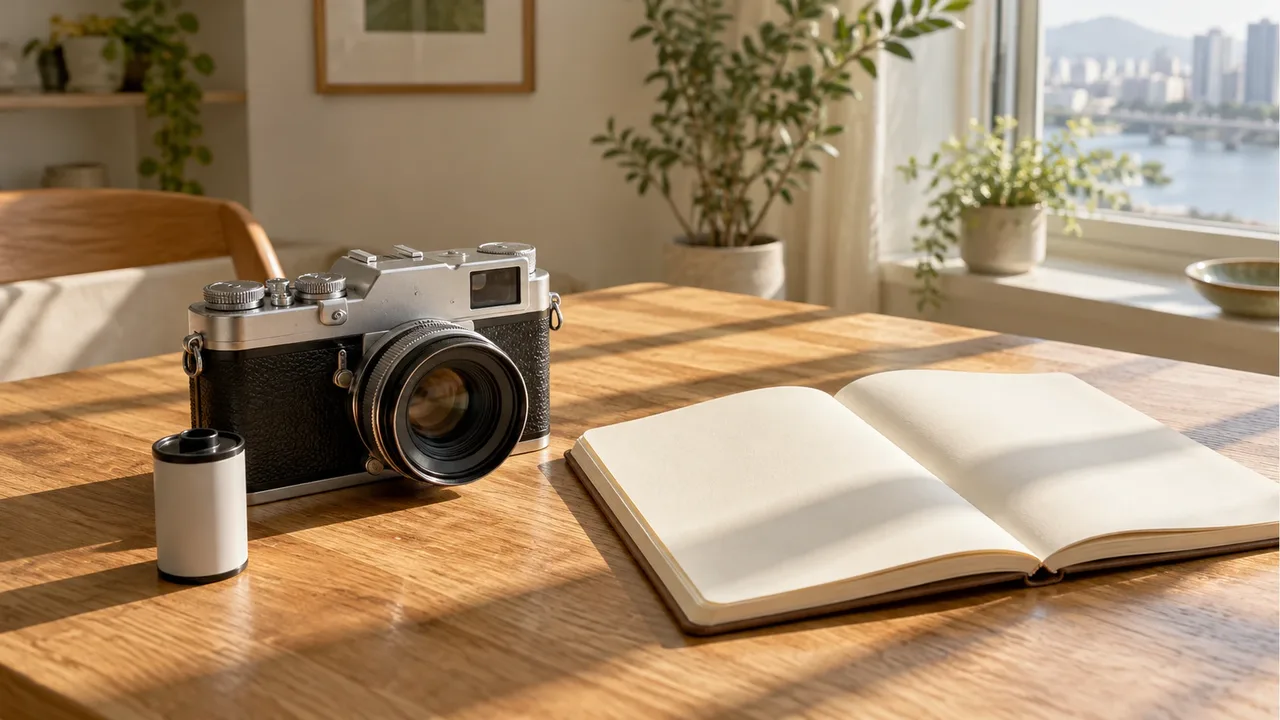
When you are out shooting and find the meter battery depleted, you do not need to pause your session. Looking at the sunlight and ground shadows gives you a reliable baseline exposure immediately.
How do you calculate the baseline for the Sunny 16 rule?
The Sunny 16 rule relies on two baseline settings. Under direct outdoor sunlight, set your aperture to f/16 and your shutter speed to the reciprocal of your film's ISO rating (1/ISO seconds).
The Kodak Professional Gold 200 technical documentation and Tri-X 400 data sheet were verified on October 26, 2026. Kodak's technical sheets specify daylight exposure values suited to each film speed under direct sunlight.
- ISO 100 film: Aperture f/16, shutter speed 1/125s (the closest standard speed to 1/100s)
- ISO 200 film: Aperture f/16, shutter speed 1/250s (the closest standard speed to 1/200s)
- ISO 400 film: Aperture f/16, shutter speed 1/500s (the closest standard speed to 1/400s)
Memorising this single calculation lets you determine your baseline outdoor exposure on any manual camera.
How do you adjust the aperture for different weather and shadows?
When clouds roll in or your subject enters shade, the amount of available light drops. Keep your shutter speed fixed at the baseline and open the aperture according to external conditions.
The simplest way to judge light intensity is by looking at shadow edges on the ground. Kodak's official daylight exposure guidance outlines the following apertures for varying weather conditions.
| Weather and shadow conditions | Recommended aperture | ISO 200 shutter speed | ISO 400 shutter speed |
|---|---|---|---|
| Bright sun on light sand or snow | f/22 | 1/250s | 1/500s |
| Bright sun with distinct shadows | f/16 | 1/250s | 1/500s |
| Weak, hazy sun with soft shadows | f/11 | 1/250s | 1/500s |
| Cloudy bright with no shadows | f/8 | 1/250s | 1/500s |
| Heavy overcast or open shade | f/5.6 | 1/250s | 1/500s |
Select f/16 when shadows are sharp and distinct, f/11 when edges soften, and f/8 or f/5.6 when shadows disappear completely.
How do you choose the nearest standard shutter speed?
Mechanical shutter speed dials rarely offer intermediate settings like 1/200s or 1/400s. Most dials step by full stops across 1/60, 1/125, 1/250 and 1/500 seconds.
In these situations, select the nearest faster shutter speed relative to your film's ISO number. For ISO 200 film, choose 1/250s; for ISO 400 film, choose 1/500s.
Negative film handles slight overexposure far better than underexposure. The official PENTAX 17 guide recommends increasing exposure compensation by +1 or +2 when photographing backlit subjects. To keep shadow details clear, opening the aperture one stop wider is safer than risking underexposure.
What points should you check before your first shot?
Before applying the rule in the field, check these mechanical camera details.
- Confirm the loaded film's ISO rating through the camera's memo holder or film window.
- Check that the aperture ring clicks firmly into each designated f-stop position.
- If your subject stands under a tree or awning, set the aperture for open shade (f/5.6) rather than the sunny background.
- At beaches or snowfields with high reflection, stop down to f/22 to avoid overexposure.
Before you begin shooting outdoors, make it a habit to check the clouds above and the shadows at your feet.
Frequently Asked Questions
What if my film camera does not have a 1/200s or 1/400s shutter speed?
Mechanical cameras typically divide shutter speeds in whole stops, such as 1/125s, 1/250s and 1/500s. Choose the closest faster speed, using 1/250s for ISO 200 film and 1/500s for ISO 400 film.
Is it safer to slightly underexpose negative film?
Colour negative film tolerates overexposure much better than underexposure. To preserve shadow detail, opening the aperture one stop wider to f/11 is generally safer than stopping down.
Can I use the Sunny 16 rule indoors?
The Sunny 16 rule is designed for direct outdoor sunlight. Indoor ambient light is significantly dimmer than daylight, so use an external flash or measure the light with a light meter.
Sources & Verification Date
- Kodak Professional Gold 200 Daylight Exposure Guidelines · Verified
- Kodak Professional Tri-X 400 Daylight Exposure Table · Verified
- PENTAX 17 shooting modes and exposure operation guide · Verified
All materials have been verified from official announcements and may have changed since verification.