Set Your Film Camera's Flash Aperture with the Guide Number
Key Takeaway
With an external flash, you set the aperture by dividing the guide number by the flash-to-subject distance. Guide numbers change with film speed and flash output, so look them up for your film first.
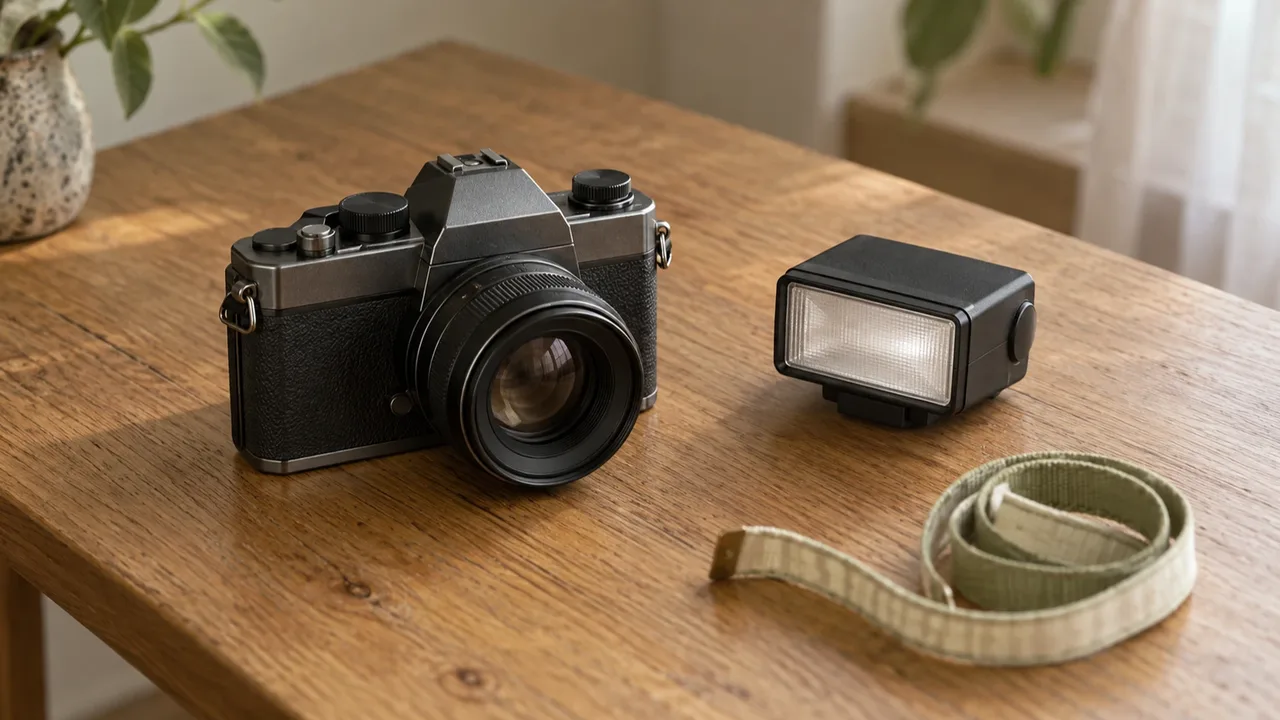
How do you calculate the aperture from a guide number?
The Kodak technical data sheets describe four steps.
- Find the electronic flash table in the data sheet for the film you loaded.
- Choose the row closest to the output (BCPS) given by your flash manufacturer.
- Read the guide number in feet or metres, matching the unit you use for distance.
- Divide that number by the flash-to-subject distance to get the aperture.
With Gold 200 and a 1400 BCPS flash, the guide number in metres is 36. For a subject 4.5 m away, 36 divided by 4.5 gives f/8. Kodak presents this value as a starting point.
How different are the guide numbers for ISO 200 and ISO 400 film?
At the same output, faster film has a larger guide number. The table below lists only the metre values from the two data sheets.
| Flash output (BCPS) | Gold 200 (ISO 200) | Portra 400 (ISO 400) |
|---|---|---|
| 500 | 21 | 30 |
| 1000 | 30 | 42 |
| 2000 | 42 | 60 |
| 4000 | 60 | 85 |
| 8000 | 85 | 120 |
We checked the Kodak Gold 200 data sheet (E-7022) and the Portra 400 data sheet (E-4050) on October 18, 2026. Each lists 10 rows from 350 to 8000 BCPS, and the table above shows five of them.
Switch the earlier example to Portra 400 and the 1400 BCPS guide number becomes 50. At the same 4.5 m, 50 divided by 4.5 is about 11, close to f/11. For help choosing a film speed, see our ISO 200 vs. ISO 400 comparison.
What if your developed negatives are too dense or too thin?
Judge by the negatives. A negative that is too dense received too much light, so use a higher guide number next time. A negative that is too thin is underexposed, so use a lower guide number.
Dividing by a higher guide number gives a larger f-number, which closes the lens down and lets in less light. On your first roll, note the distance and aperture for each frame so you can tell which way to adjust after processing. For what to ask the lab, see our C-41 processing and scanning guide.
What should you watch for indoors without a flash?
Under fluorescent lights, keep the shutter at 1/60 second or slower. The Gold 200 data sheet explains that this avoids the brightness and color variations that occur within a single alternating-current cycle.
The same data sheet also lists correction filters and exposure adjustments for each type of fluorescent lamp. If you do not know the lamp type, it suggests a 10C + 20M filter combination with a 2/3-stop exposure increase. It adds that color rendition may still be less than optimum.
What should you check in the manuals before shooting?
Open your camera and flash manuals and check these three things.
- See whether the flash output is listed in BCPS, or, if a guide number is listed, which film speed and distance unit it assumes.
- Find in the camera manual how it connects to an external flash and which shutter speed to use with flash.
- A single-use camera with a built-in flash has a fixed aperture, so check the flash range in our single-use camera comparison first.
If you measure distance in metres, read only the metre values in the table. Mixing in the feet values will throw your calculated aperture far off.
Frequently Asked Questions
What if the result falls between two aperture marks?
Pick one of the two nearest marks and take a second frame of the same scene at the other mark so you can compare the results. Kodak also recommends a series of test exposures for critical work.
Can I use the Kodak table if my flash manual does not list BCPS output?
The Kodak table uses BCPS output to choose a row. If your manual lists no output figure, use the guide number it gives, but first check which film speed and distance unit that number assumes.
Is there anything to watch for under fluorescent light without a flash?
The Kodak Gold 200 data sheet recommends exposure times of 1/60 second or longer under fluorescent lamps. This avoids the brightness and color variations that occur within a single alternating-current cycle.
Sources & Verification Date
- Kodak Gold 200 technical data (E-7022) · Verified
- Kodak Professional Portra 400 technical data (E-4050) · Verified
All materials have been verified from official announcements and may have changed since verification.