Correct Your Black-and-White Film's Long Exposure with the Reciprocity Formula
Key Takeaway
For long exposures on black-and-white film, check its reciprocity correction. A metered 10 seconds on Ilford HP5 Plus becomes about 20 seconds. Enter seconds and choose the exponent for your film.
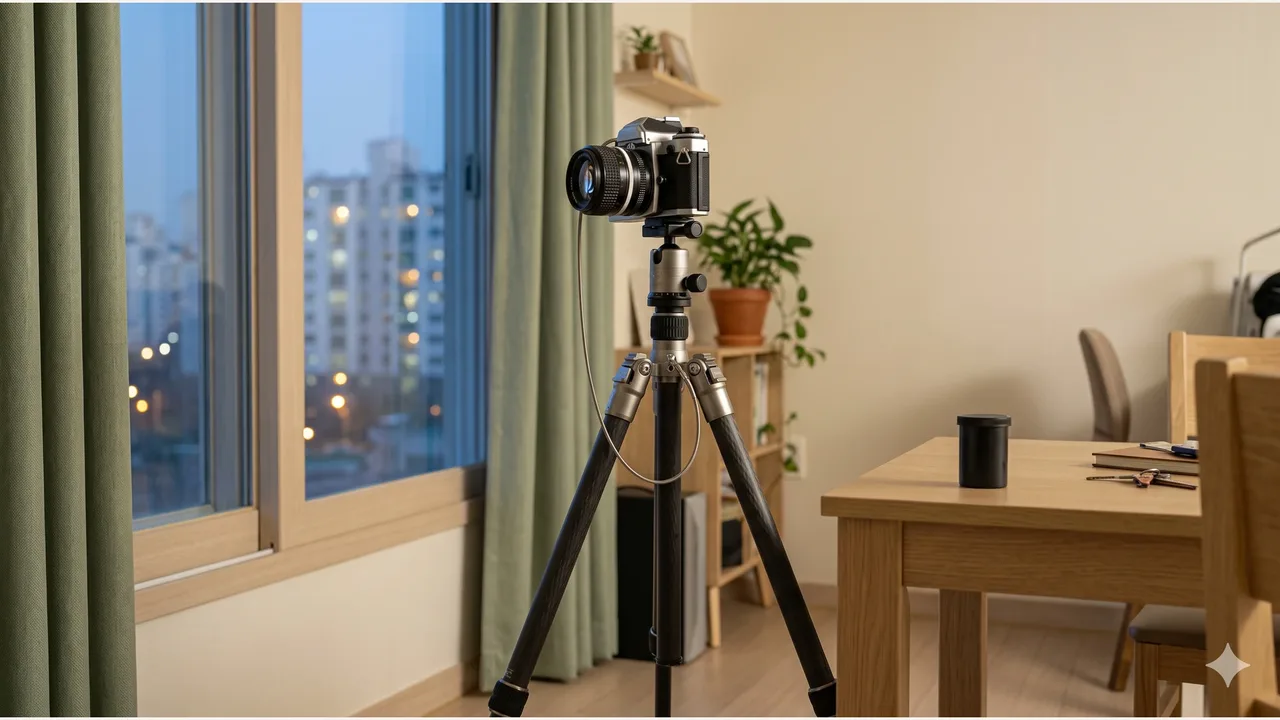
Why expose longer than the meter indicates?
Under dim light over a long period, film can produce a thinner negative than the meter predicts. This is called reciprocity failure. Even with the same film, the time calculation used for short exposures may not work for long ones.
Ilford's December 2023 compensation sheet says exposures of one second or less need no correction. The table here covers only metered times longer than one second for three films in that document. For other manufacturers or color film, consult that film's technical information.
How do you calculate the time for your film?
The formula is corrected time = metered time raised to P. Enter all times in seconds. P is the exponent assigned to the film, not a multiplier for the metered time.
- Check the exact name of the film you loaded.
- Write down the metered time in seconds.
- Use a scientific calculator's power function to raise it to that film's P value.
- Read the result in seconds and transfer it to your timer.
For HP5 Plus, P is 1.31. With a metered 10 seconds, 10 ^ 1.31 gives about 20.4 seconds. Ilford rounds this example to 20 seconds. Multiplying 10 × 1.31 gives 13.1 seconds, so check which button you use.
How do FP4 Plus and HP5 Plus corrections differ?
These are calculated results for the same metered times. The exponents are P=1.26 for FP4 Plus, P=1.31 for HP5 Plus and P=1.41 for Delta 400.
| Metered time | FP4 Plus corrected time | HP5 Plus corrected time | Delta 400 corrected time |
|---|---|---|---|
| 5 seconds | 7.6 seconds | 8.2 seconds | 9.7 seconds |
| 10 seconds | 18.2 seconds | 20.4 seconds | 25.7 seconds |
| 30 seconds | 72.6 seconds | 86.1 seconds | 121.0 seconds |
| 60 seconds | 174.0 seconds | 213.5 seconds | 321.5 seconds |
The Ilford technical sheet was checked on October 19, 2026. These values were calculated from its formula and rounded to one decimal place; they are not measured shooting results. When you change films, meter again at the film's speed. Each row compares calculations only when the metered time is the same.
What should you check on the camera?
Find in your camera manual how to keep the shutter open for a long exposure. Check B or T settings, the release connection and battery requirements for your specific model. Confirm what the camera supports before timing the calculated exposure.
For a first attempt, record the film name, aperture, metered time, corrected time and actual time the shutter stayed open on the same line. If operating the shutter adds time, keeping the actual duration separately lets you compare it after processing. Check loading first with the film loading and rewinding guide.
Can you rely on the calculated time in very dark scenes?
Ilford adds that very long exposures in very low light may require trial and error because other variables, including metering accuracy, have an effect. Keep notes for comparison on the next roll rather than treating the calculated time as a guaranteed result.
When handing the roll to a lab, mention the long-exposure frames and include your shooting notes. Consult film- and developer-specific information for development times, and explain what is on the other frames of the roll too. Once the negatives return, keep them with the frame notes using the guide to choosing negative storage sleeves.
Frequently Asked Questions
Should I use the exp button on my calculator?
Do not choose a button by its name alone. Ilford specifies the x-to-the-power-of-y button, xʸ. Enter 10, xʸ, 1.31 and equals, then check that the result is about 20.4.
If the metered time is one minute, should I enter 1?
Enter 60. The formula uses seconds, so convert one minute to 60 seconds first. For HP5 Plus, 60 raised to 1.31 gives about 213.5 seconds.
Should I always reduce development time for a long exposure?
Do not apply the same reduction to every scene. Ilford says long exposures can increase contrast and may require pull processing, depending on the scene's brightness range. Check the technical information for your film and developer and discuss it with your lab.
Sources & Verification Date
- Ilford Film Reciprocity Failure Compensation technical information (December 2023) · Verified
- Ilford film FAQs on long-exposure compensation and development times · Verified
All materials have been verified from official announcements and may have changed since verification.